
5G High-Frequency High-Speed and Microwave Board
Category: Communication Products
Product Details
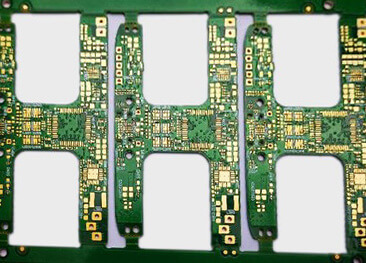
The design of high-frequency microwave multilayer boards made by mixing high-frequency substrates with FR-4 has a higher density than low-frequency boards. Generally, high-frequency boards are used in circuits with frequencies above 1G. Its dielectric constant is key, with a very small and stable DK value, very low dielectric loss, and excellent properties such as resistance to moisture absorption, heat resistance, and corrosion resistance.
Main process characteristics
① Low loss, high reliability;
② High-frequency characteristics;
③ High-frequency PCB structure;
Type: Tu M series high-frequency board material
Technical indicators: high-frequency board material, low dielectric constant, low dielectric loss
Finished board thickness: 1.6+/-0.1mm
Copper foil thickness: 70um
Surface treatment: thick gold process 15u''
Dimensional accuracy: 0.05mm
Characteristics of microwave printed circuit board manufacturing
The characteristics of microwave printed circuit board manufacturing are mainly reflected in the following aspects:
1. Diversification of substrates:
For a long time, the most commonly used domestic material was domestically produced glass cloth reinforced PTFE copper-clad laminate. However, due to its single variety and poor uniformity of dielectric properties, it has become increasingly unsuitable for some high-performance applications. Since the 1990s, the RT/Duroid series and TMM series microwave substrate boards produced by the American Rogers company have been gradually applied, mainly including glass fiber reinforced PTFE copper-clad laminate, ceramic powder filled PTFE copper-clad laminate, and ceramic powder filled thermosetting resin copper-clad laminate. Although expensive, their excellent dielectric and mechanical properties still have a considerable advantage over domestic microwave printed circuit board substrates. Currently, these types of microwave substrates, especially those with aluminum backing, are being widely used.
2. High precision design requirements:
The pattern manufacturing accuracy of microwave printed circuit boards will gradually improve, but due to the limitations of the manufacturing process itself, this accuracy improvement cannot be unlimited and will stabilize at a certain level. The design content of microwave boards will be greatly enriched. In terms of types, there will not only be single-sided and double-sided boards but also microwave multilayer boards. Higher requirements will be proposed for grounding microwave boards, such as generally solving the hole metallization of PTFE substrates and grounding of microwave boards with aluminum backing. Plating requirements will become more diversified, with special emphasis on the protection and plating of aluminum backing. Additionally, higher requirements will be proposed for the overall three-proof protection of microwave boards, especially the three-proof protection of PTFE substrates.
3. Computer control:
Traditional microwave printed circuit board production rarely applied computer technology, but with the widespread use of CAD technology in design and the high precision and large volume of microwave printed circuit boards, the extensive application of computer technology in microwave printed circuit board manufacturing has become an inevitable choice. High-precision microwave printed circuit board template design and manufacturing, numerical control machining of shapes, and batch production inspection of high-precision microwave printed circuit boards have become inseparable from computer technology. Therefore, it is necessary to connect microwave printed circuit board CAD with CAM and CAT, generate corresponding numerical control machining files and inspection files through CAD design data processing and process intervention, for process control, process inspection, and finished product inspection in microwave printed circuit board production.
4. Specialization of high-precision pattern manufacturing:
The high-precision pattern manufacturing of microwave printed circuit boards is developing towards a more specialized direction compared with traditional rigid printed circuit boards, including production and process control technologies for high-precision template manufacturing, high-precision pattern transfer, and high-precision pattern etching, as well as reasonable manufacturing process route arrangements. For different design requirements, such as whether to metallize holes and types of surface plating, reasonable manufacturing process methods are formulated. After extensive process experiments, process parameters of related processes are optimized, and process allowances for each process are determined.
5. Diversification of surface plating:
With the expansion of the application range of microwave printed circuit boards, the environmental conditions of use have become more complex. At the same time, due to the extensive use of aluminum-backed substrates, higher requirements have been proposed for surface plating and protection of microwave printed circuit boards beyond the original chemical silver plating and tin-cerium alloy plating. First, the plating and protection of microstrip pattern surfaces need to meet the welding requirements of microwave devices, using nickel-gold electroplating technology to ensure that microstrip patterns are not damaged in harsh environments. Besides the solderable plating layer on the microstrip pattern surface, the most important is to solve the three-proof protection technology that effectively protects without affecting microwave performance. Second, protection and plating technology for aluminum backing. Without protection, aluminum backing exposed to humid and salt spray environments will corrode quickly. Therefore, with the widespread use of aluminum backing, its protection technology should be given sufficient attention. Additionally, research is needed to solve aluminum plating technology, as the demand for electroplating silver, tin, and other metals on aluminum backing surfaces for microwave device welding or other special purposes is increasing. This involves not only aluminum plating technology but also protection issues for microstrip patterns.
6. Numerical control of shape processing:
The shape processing of microwave printed circuit boards, especially the three-dimensional shape processing of microwave printed circuit boards with aluminum backing, is a key technology that needs to be solved for batch production. Facing thousands of microwave printed circuit boards with aluminum backing, traditional shape processing methods cannot guarantee manufacturing accuracy and consistency, nor production cycles, so advanced computer-controlled numerical control machining technology must be used. However, the shape processing technology of aluminum-backed microwave printed circuit boards differs from both metal and non-metal material processing. Due to the coexistence of metal and non-metal materials, its processing tools, parameters, and machines have great particularity, and many technical problems need to be solved. Shape processing is the longest process in microwave printed circuit board manufacturing, so the quality of shape processing technology directly affects the overall processing cycle and impacts product development or production cycles.
7. Batch production inspection equipment:
Microwave printed circuit boards differ from ordinary single-sided, double-sided, and multilayer boards. They not only serve as structural and connecting components but, more importantly, function as signal transmission lines. This means that for the electrical testing of microwave printed circuit boards used for high-frequency and high-speed digital signal transmission, it is necessary not only to measure whether the circuit (or network) meets requirements such as "continuity," "disconnection," and "short circuit," but also to measure whether the characteristic impedance value falls within the specified acceptable range.
In addition, high-precision microwave printed circuit boards require inspection of a large amount of data, such as pattern accuracy, positional accuracy, registration accuracy, plating thickness, and three-dimensional dimensional accuracy of the outline. Currently, domestic batch production inspection technology for microwave printed circuit boards is very backward. The current method is mainly manual visual inspection, supplemented by some simple measuring tools. This primitive and simple inspection method is difficult to meet the batch production requirements of microwave printed circuit boards with hundreds or thousands of data points. It not only results in long inspection cycles but also many errors and omissions, thus forcing the manufacturing of microwave printed circuit boards to develop towards batch production inspection equipment.
Keywords:5G High-Frequency High-Speed and Microwave Board
Previous: Communication Board
Next: No more!
5G High-Frequency High-Speed and Microwave Board
The design of high-frequency microwave multilayer boards made by mixing high-frequency substrates with FR-4 has a higher density than low-frequency boards. Generally, high-frequency boards are used in circuits with frequencies above 1G. Its dielectric constant is critical; the DK value is very small and stable, dielectric loss is minimal, and it has excellent properties such as resistance to moisture absorption, heat resistance, and corrosion resistance.
Related Products
Product Inquiry
Leave the information you want to inquire about, and we will contact you as soon as possible
Customer Service Hotline
E-MAIL:yinyaoming@ltepcb.com
Address: Longteng Industrial Park, Xiaochang Economic Development Zone, Xiaogan City, Hubei Province
QR Code
This website supports dual access via IPV4 / IPV6
Copyright © 2025 HOME FLAVOR ALL RIGHTS RESERVED.